Step 1. The big picture
In one sentence…
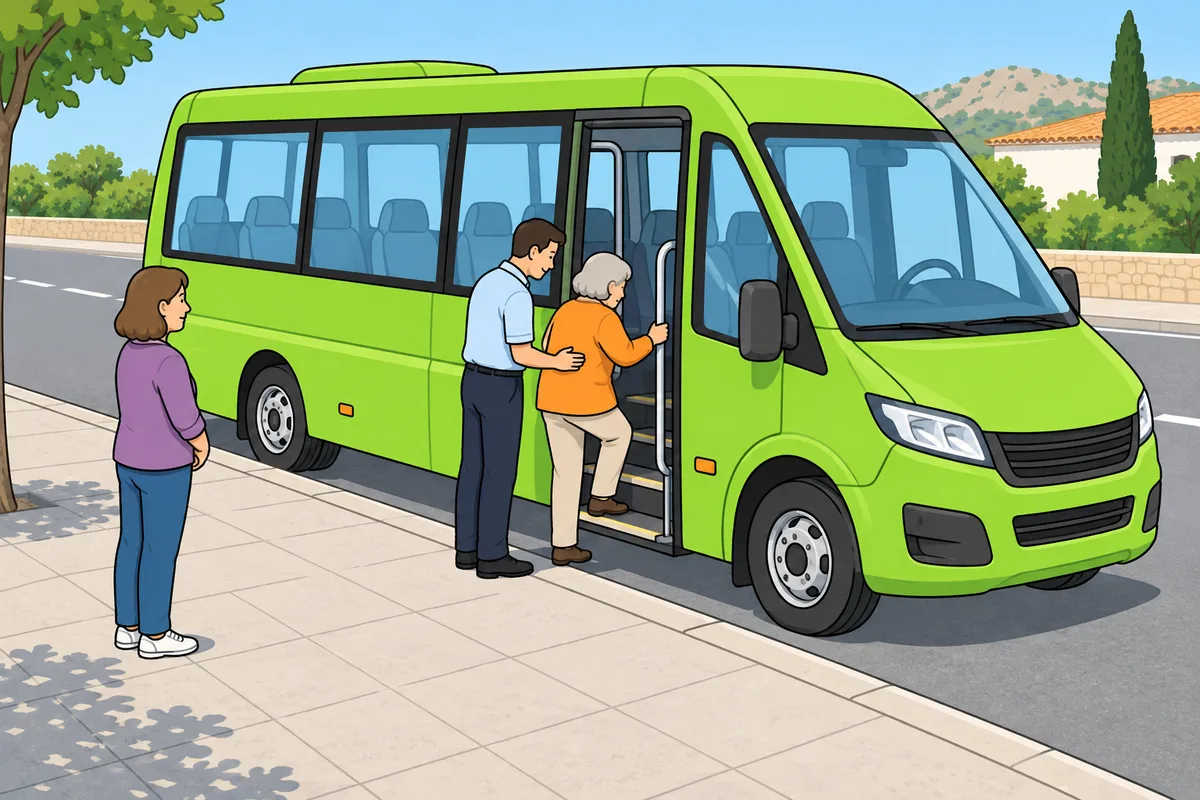
Passenger transport requires technique, regulatory knowledge and safe treatment of passengers: access, luggage, information, attention to vulnerable groups and the correct response to incidents. On the D1 licence, driving is always studied together with the service received by the people being transported.
Step 2. The syllabus
2.1Passenger safety
Passengers must be able to board, alight and travel without avoidable risk arising from the driving or the management of the vehicle.
- The driver must anticipate how braking, turning, accelerating and stopping will affect people who may be seated, standing or moving about.
- Passenger safety begins before you set off: doors, exits, aisles, luggage and the stopping environment must all be under control.
- In the exam, many correct answers reduce interior risk even when they do not change the vehicle's outward path, throughout the passenger service.
2.2Access, alighting and stops
The stop must allow boarding and alighting without exposing passengers to traffic, kerbs, obstacles or unexpected movements of the vehicle.
- Before moving off again, check that no one is still boarding, alighting, crossing nearby or standing in a dangerous spot, throughout the passenger service.
- Clear information and stopping in a safe place are part of responsibly managing passenger transport, throughout the passenger service.
- Do not let pressure to keep to schedule become the deciding factor; if safety is lacking, you must wait or correct the situation, throughout the passenger service.
2.3Luggage, exits and interior space
The placement of luggage and objects must not block exits, aisles or functional areas of the minibus, throughout the passenger service.
- A badly placed object can shift during braking, hinder an evacuation or cause falls and knocks inside the vehicle.
- The driver must detect interior risks before driving, not only react once the luggage has already shifted, throughout the passenger service.
- When the exam mentions objects or aisles, think about accessibility, evacuation, stability and passenger safety, throughout the passenger service.
2.4Especially vulnerable groups
Children, older people, users with reduced mobility and disoriented passengers need extra time and caution, throughout the passenger service.
- Safe professional driving does not speed up the process at the expense of the slowest or most vulnerable passenger, throughout the passenger service.
- With these groups, pulling away, braking or closing the doors abruptly can have consequences even if outside traffic seems under control.
- In exam questions, identify whether a vulnerable user appears, because this usually changes the margin of caution required, throughout the passenger service.
2.5Driving during the service
Smoothness in acceleration, braking and steering is part of safety, not a secondary matter of comfort, throughout the passenger service.
- Maintaining wide observation lets you anticipate incidents and avoid abrupt manoeuvres that affect passengers, throughout the passenger service.
- Professional driving avoids unnecessary hard braking, tight turns without control and late corrections near stops or junctions, throughout the passenger service.
- If an answer justifies an abrupt manoeuvre to save time, it usually ignores the specific responsibility of passenger transport, throughout the passenger service.
2.6Incidents and breakdowns
In the event of a breakdown or incident, prioritise protecting passengers, the visibility of the vehicle and coordination with emergency services if needed.
- The first decision must reduce risk to people: positioning the vehicle safely, informing passengers clearly and avoiding unnecessary exposure.
- Do not abandon passenger management to focus only on the mechanical breakdown; both are part of a safe service.
- The exam may present a minor incident to check whether you keep your priorities straight: people, visibility, order and communication, throughout the passenger service.
2.7How to prepare this topic
Study each situation from three angles: what the passenger needs, what risk the vehicle creates and what the driver must check.
- Link regulation and technique: doors, luggage, stops and smoothness are not separate topics when you are carrying people, throughout the passenger service.
- Practise spotting answers that are too mechanical, because they usually forget about information, safe treatment or vulnerable groups, throughout the passenger service.
- When in doubt, choose the option that protects people first and only then allows the service to continue in an orderly way.
Step 3. Key points
If you only have a minute before the exam, revise this.
- 1.Secure luggage, exits, aisles and interior safety before driving.
- 2.Pay extra attention to children, older people and people with reduced mobility.
- 3.Control boarding, alighting and the stopping environment before opening the doors or pulling away.
- 4.Drive smoothly to avoid falls, knocks and unsafe reactions.
- 5.Inform passengers clearly whenever an incident affects the service.
- 6.Manage breakdowns by protecting the people being transported first.
- 7.Link each exam answer to interior and exterior safety.
- 8.Rule out solutions that prioritise speed over the caution the service requires.
Step 4. Exam traps
Mistakes the DGT uses again and again on this topic.
- Reducing passenger transport to simply driving the vehicle.
- Forgetting that unnecessary hard braking is also a service-safety failure.
- Allowing luggage that blocks exits or aisles because it looks well secured.
- Pulling away without checking that boarding and alighting have finished safely.
- Treating vulnerable passengers the same as any other user without an extra margin.
- Focusing on the breakdown and forgetting information, visibility and passenger protection.
Step 5. Quick check
Four real exam questions on what you have just read.
While passengers are boarding or alighting, the bus driver must not:
Step 6. Frequently asked questions about passenger transport
- On a bus fitted with seat belts, before or at the start of the journey passengers subject to the rule should be reminded that:
- They must wear the seat belt while the vehicle is moving. Passengers subject to the rule must wear the belt while the vehicle is moving, rather than only above 90 km/h or at each adult’s discretion. In vehicles with more than nine seats, information is provided by the driver, guide or group leader, audiovisual means, or the prescribed notices or pictograms. Exemptions and specific child-restraint rules apply in their corresponding cases; the question concerns passengers subject to the obligation on a bus fitted with belts.See full question
- On a bus, hand luggage and other objects must not:
- Obstruct aisles or exits. The aisle and access points must remain clear so as not to hinder passenger safety.See full question
- On a bus fitted with seat belts, adult passengers with no applicable exemption must...
- Use them while the bus is moving. They must wear the belt properly fastened while the vehicle is moving, on both urban and interurban roads. A short journey does not remove the obligation. This question excludes applicable exemptions; children also have specific restraint rules. In vehicles with more than nine seats, passengers are informed using the means in Article 117, such as the driver, guide, audiovisual information or notices and pictograms.See full question
- In a D1 or D bus, passengers and hand luggage also must not:
- Reduce the driver's field of vision. The arrangement of load, luggage, or objects must not reduce the driver's field of vision.See full question
- In passenger transport, regarding people with reduced mobility, the driver must:
- Facilitate safe boarding and alighting. The driver must facilitate safe boarding and alighting and pay special attention to vulnerable passengers.See full question
Official sources
- BOE - Traffic, Motor Vehicle Circulation and Road Safety Act (Ley sobre Tráfico, Circulación de Vehículos a Motor y Seguridad Vial) (RDL 6/2015)
- BOE - General Traffic Regulations (Reglamento General de Circulación) (RD 1428/2003)
- BOE - General Vehicle Regulations (Reglamento General de Vehículos) (RD 2822/1998)
Test what you've studied on passenger transport
Exam-style questions on this topic, with an explanation after every answer.
Now, practise it
Test what you have read with exam-style questions and an explanation after each answer.
Related lessons
- DPassenger transport
Passenger transport requires technique, regulatory knowledge and safe treatment of passengers: access, luggage, information, attention to vulnerable groups and the correct response to incidents. On the D licence, driving is always studied together with the service received by the people being transported.
- D1Mechanics and maintenance
Preventive maintenance of buses and minibuses is part of road safety: it prevents breakdowns, reduces braking distance, improves stability and cuts down on exam and real-driving errors. On the D1 licence you must treat it as part of your routine as a driver, not as a task left to the garage.
- D1Passenger-transport regulations
On the D1 licence you must master passenger-transport regulations: the scope of the licence, passenger safety, stops, doors, luggage and the extra margin of caution required by the vehicle's size and responsibility. The exam does not separate the regulation from conduct: it asks you to decide how to protect passengers in specific situations.
- D1Signs
Master the hierarchy between officers, temporary signalling, traffic lights, vertical signs and road markings, and study the current official catalogue with attention to the most recent updates. On passenger-transport licences, reading a sign late can compromise turns, stops, reserved lanes and access restrictions.
- D1Bus driving techniques
Driving a minibus requires smoothness, wide observation, control of body roll and respect for the swept path in turns. Passengers feel every mistake even before the external hazard appears, which is why correct technique combines anticipation, precision and calm.
- D1Driving and rest times
Driving and rest times for passenger transport are based on Regulation (EC) 561/2006. The aim is to limit driver fatigue and protect passengers and other road users; in the exam you must know both the figures and the purpose of each break or rest period.