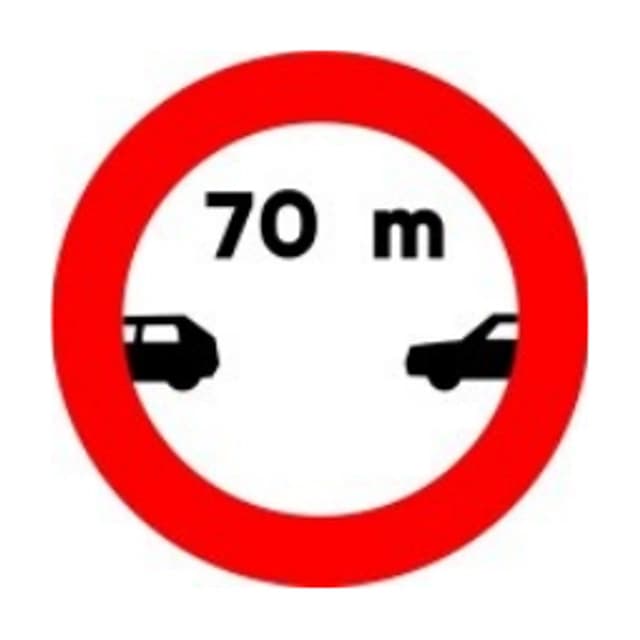
Correct answer
A minimum gap of 70 metres.
At least 70 metres. R-300 prohibits driving without a gap at least equal to the stated distance, except to overtake. It does not specify a maximum gap. Article 54.1 still requires the gap needed to avoid collision: keep more distance if speed, grip or other circumstances require it. The overtaking exception does not permit following so closely that you cannot stop without a collision.
Practice more B licence questions
A 3-minute quick test with exam-style questions. Free, no signup.
All options
Exactly 50 metres, even if conditions require more.
A minimum gap of 70 metres.
A maximum gap of 70 metres.
Editorial status: editorially approved. This status does not certify legal review. Report a correction
Keep studying
DGT test in English: free practice
Exam-style questions in English, no signup. You can also sit the official exam in English.
All Spanish traffic signs and their meanings
Full DGT catalogue: warning, regulatory and information signs.
Sign R-300: establishes a minimum separation
What this sign means, its category and its shape.
Glossary terms in this question
Related questions
- In tunnels with one lane for each direction, is overtaking prohibited?
- If a vehicle is overtaking you and the manoeuvre is going to create a dangerous situation, what should you do, as a general rule?
- In ordinary traffic, with no officer directing otherwise, may you overtake a moving passenger car at or near a marked pedestrian crossing merely by doing so very slowly?
- At a crest with restricted visibility on a two-way road, overtaking a passenger car requires entering the opposing direction. Does a broken longitudinal line authorise it?
- On a section where overtaking is prohibited and a U-turn is not expressly authorised, may you reverse your direction of travel?
- On a Spanish autopista, traffic fills the carriageway width and each row can move only at the speed of the vehicle ahead. May the row in the right lane progress faster than the left-lane row?