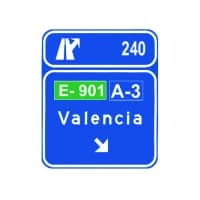
Correct answer
A motorway or dual carriageway.
The blue sign indicates an immediate exit towards a motorway or dual carriageway, here A-3 towards Valencia. 240 is the exit number, not a distance of 240 kilometres. Valencia is the named destination, while the question asks for the road type; these are separate, compatible facts. Follow the indicated branch while respecting traffic rules and avoiding abrupt lane changes.
Practice more B licence questions
A 3-minute quick test with exam-style questions. Free, no signup.
All options
A conventional road with no motorway or dual-carriageway access.
A motorway or dual carriageway.
An urban street with no motorway or dual-carriageway access.
Editorial status: editorially approved. This status does not certify legal review. Report a correction
Keep studying
Glossary terms in this question
Conventional road
Interurban road that is not a motorway, dual carriageway or expressway.
Dual carriageway
Fast road with separated carriageways per direction and at least two lanes each way, no at-grade intersections.
Motorway
Top-grade public road with separated carriageways, no direct property access, restricted to motor vehicles.
Related questions
- Do adjoining properties have direct access to a motorway?
- A private car driver misses a motorway exit. May they reverse to reach it?
- To leave a dual carriageway at an exit with a deceleration lane, what must you do?
- On a long motorway journey, which measure helps prevent fatigue associated with prolonged, monotonous driving?
- Is it permitted to make a U-turn on a motorway?
- May we stop in a lane of a motorway carriageway?