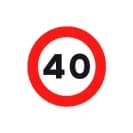
Correct answer
An end-of-prohibitions sign.
The image shows a vertical R-301 40 km/h sign, not a road marking. Its restriction ends at an end-of-prohibitions sign, an end-of-speed-limit sign or another maximum-speed sign. When on the same post or panel as a danger warning, it ends when that danger ends; on a non-priority road, it ceases after leaving a junction with a priority road. General limits and other restrictions still apply.
Practice more B licence questions
A 3-minute quick test with exam-style questions. Free, no signup.
All options
A sign warning of a pedestrian crossing.
An end-of-prohibitions sign.
A parking sign.
Editorial status: editorially approved. This status does not certify legal review. Report a correction
Keep studying
DGT test in English: free practice
Exam-style questions in English, no signup. You can also sit the official exam in English.
All Spanish traffic signs and their meanings
Full DGT catalogue: warning, regulatory and information signs.
Sign R-301: sets a maximum speed
What this sign means, its category and its shape.
Glossary terms in this question
Related questions
- A passenger car tows a trailer with a 700 kg maximum authorised mass on a dual carriageway outside a built-up area, with no lower posted limit or special regime. What is its general maximum?
- What does this traffic sign indicate?
- A passenger car enters thick fog that greatly reduces visibility. How must it adapt its speed?
- To anticipate danger, it is very important that the driver...
- On a motorway outside a built-up area, a passenger car without a trailer or special regime travels on a section with no lower posted limit. How must it choose its speed?
- Is it possible to save fuel by avoiding unnecessary gear changes?