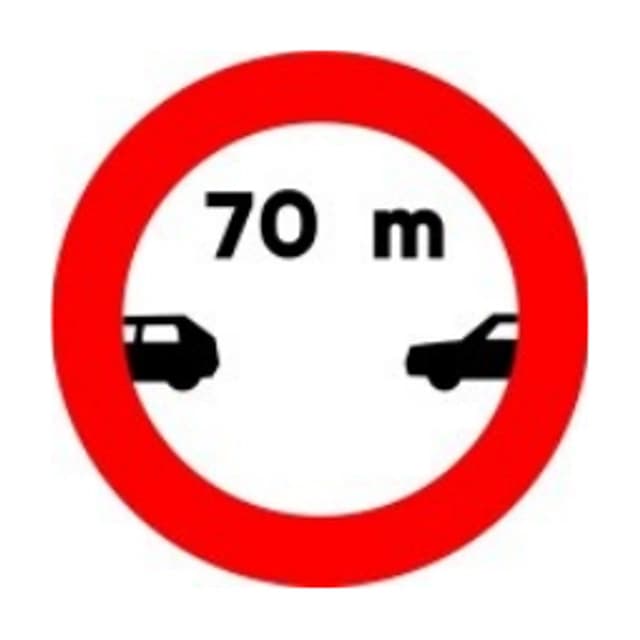
Correct answer
Equal to or greater than 70 metres.
R-300 requires a gap of at least the displayed 70 metres. It is not limited to following a car and does not set a maximum gap. Increase the margin when conditions require it to stop safely, and observe any other applicable minimum. The overtaking-intention exception does not apply to this question.
Practice more C1 licence questions
A self-check with exam-style questions on Traffic signs. Free, no signup.
All options
Equal to or less than 70 metres.
Equal to or greater than 70 metres.
70 metres, but only if driving behind a car.
Editorial status: editorially approved. This status does not certify legal review. Report a correction
Keep studying
DGT test in English: free practice
Exam-style questions in English, no signup. You can also sit the official exam in English.
All Spanish traffic signs and their meanings
Full DGT catalogue: warning, regulatory and information signs.
Sign R-300: establishes a minimum separation
What this sign means, its category and its shape.
Glossary terms in this question
Related questions
- To overtake a vehicle that is signalling with its indicator that it is about to change direction to the left, how will you carry out the manoeuvre?
- If we arrive in our lorry at a narrow section that does not allow two vehicles to pass simultaneously, and at the same time, but travelling in the opposite direction, a rider of a motorcycle without a sidecar arrives, which vehicle must pass first if there is no sign regulating passage?
- While driving your lorry, you meet a combination of vehicles at a narrow passage that does not allow two vehicles to pass simultaneously. The combination of vehicles arrives at the same time. In the absence of signs, which vehicle must reverse?
- Which vehicles will be required to carry the V-6 long vehicle sign on the rear?
- Two ordinary lorries arrive simultaneously at an unsignalled narrow passage where they cannot pass each other and one must reverse. One is towing a trailer. There is no steep gradient or controlling instruction. Who has priority?
- A lorry over 3,500 kg MAM travels normally on an urban carriageway that is neither a motorway nor a dual carriageway, wide enough for three lanes in its direction but without longitudinal lane markings. Without a manoeuvre justifying otherwise, where must it travel?