What really changes in the 2026 DGT exam
When people talk about changes to the DGT exam, it is worth separating noise from what matters. It does not mean the whole exam becomes new or that you should discard everything you have studied. Usually, the updates affect emphasis, signs, and the kinds of situations used to test real driving judgment.
For 2026, focus on two clear lines: more applied questions and more current traffic scenarios. The base remains the same: rules, signs, priority, speed, documents, road safety, and risk behavior. What changes is how the exam checks whether you can use that theory in a specific situation.
Think of these changes as an update in priorities. A question that previously could be solved by remembering a definition may now ask you to apply that definition to an urban scene with several road users. So, while studying, move from “what does the rule say” to “what would I do here and why”.
If an update creates doubt, use a practical rule: keep what you already know, verify what is new, and train with reviewed questions. Preparation should not depend on rumors, but on material that explains why an answer is correct. That way you can adapt to 2026 without losing the base you had already built.
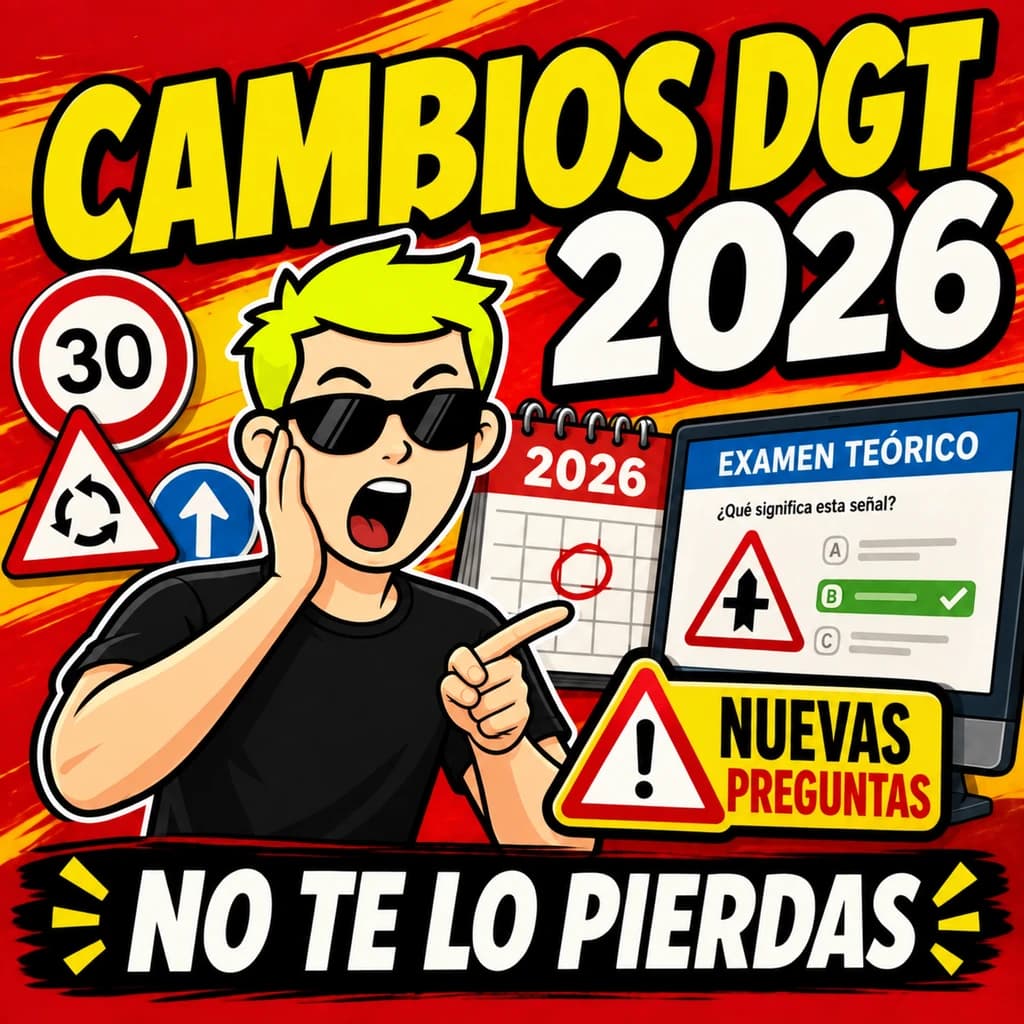
Video questions and hazard anticipation
The most relevant new point is the introduction of video-based questions to test hazard anticipation. The goal is not to memorize a scene, but to recognize what may happen before it happens: a pedestrian approaching, a vehicle entering your path, a bicycle in a shared area, or a sign that forces you to adjust speed.
To prepare, do not study definitions only. Practice describing what you see, what risk appears, and what safe decision you would make. In this type of question, observation matters: looking ahead, detecting vulnerable users, anticipating braking, and avoiding answers based only on street habits.
A useful exercise is to pause the scene mentally at three moments: before the risk, when it appears, and when you must decide. This trains your observation and prevents impulsive answers. It also helps you separate a real hazard from a visual distraction inside the scene.
New signs and the updated catalog
The official sign catalog was updated effective 2025-10-01, and recent study material may include it. The blocks to review include signs for VMP and scooters, coexistence zones, environmental restrictions, and 2+1 roads.
Recognizing the drawing is not enough. Ask what each sign requires from the driver: whether it prohibits, obliges, warns, informs, or restricts access. Many doubts appear because the learner remembers a similar image but not the practical consequence.
Signs linked to modern mobility often appear together with traditional signs. Review how they combine with speed limits, access restrictions, or shared lanes. If you study each sign in isolation, you may miss it when the test places it inside a context with several obligations at once.
As a final rule, always compare your material with the review date it shows. An updated test does not only change questions: it also removes old approaches and explains new items with context. That traceability helps you study with less anxiety and know why you are spending time on each block.
Topics to review in more detail
The areas that had already become more important remain priorities: bicycles, scooters, low-emission zones, urban speed limits, safe following distance, and interaction with vulnerable road users. They are common because they reflect real urban mobility conflicts.
It is also worth reviewing less common signs, priority at intersections, maneuvers on shared roads, and adverse conditions. The DGT often tests applied understanding: it does not want a sentence from the manual, but the safe and legal answer in a concrete case.
Do not turn this review into an endless list. Start with the topics you already miss and add the new blocks on top. If time is limited, updated signs, vulnerable users, and urban situations should come before repeating questions you already answer consistently.
How to adapt without starting over
If you have already studied the basic theory, do not restart your preparation. First review your mistakes, group them by topic, and add a focused pass on new signs, urban mobility, and risk perception. Then return to full mock exams to check whether your score is stable.
A simple routine works well: short theory review, recent test, and written review of mistakes. For every mistake, write why you chose wrong and which word in the question changed the answer. That prevents you from depending on visual memory of repeated questions.
Checklist before taking the exam
Before booking or confirming your date, check that your material is updated and that you are not using old tests without review. Do mock exams with a time limit, because the permiso B exam has 30 multiple-choice questions, allows a maximum of 3 errors, and lasts 30 minutes.
In the final week, prioritize signs, priority, speed, road safety, and risk questions. Do not try to learn everything at once on the last day. It is more useful to arrive with a short list of solved doubts than with many unrevised tests.
Do I need to study everything again because of the 2026 changes?
No. If your base is solid, you need to update specific blocks and practice recent questions. The fundamentals of the exam are still necessary, so the efficient approach is to reinforce the new material without abandoning the classic topics.
Do video questions replace the normal test?
You should not treat them as a full replacement. They are a way to add more realistic situations and measure hazard anticipation. Keep preparing multiple-choice questions, signs, rules, and practical cases.
Where should I check the final information?
Use updated study material and check official information on dgt.es when you have doubts about exam sessions, format, or procedures. For studying, rely on clear explanations rather than alarmist lists that mention changes without explaining what to practice.